Book Appointment Now

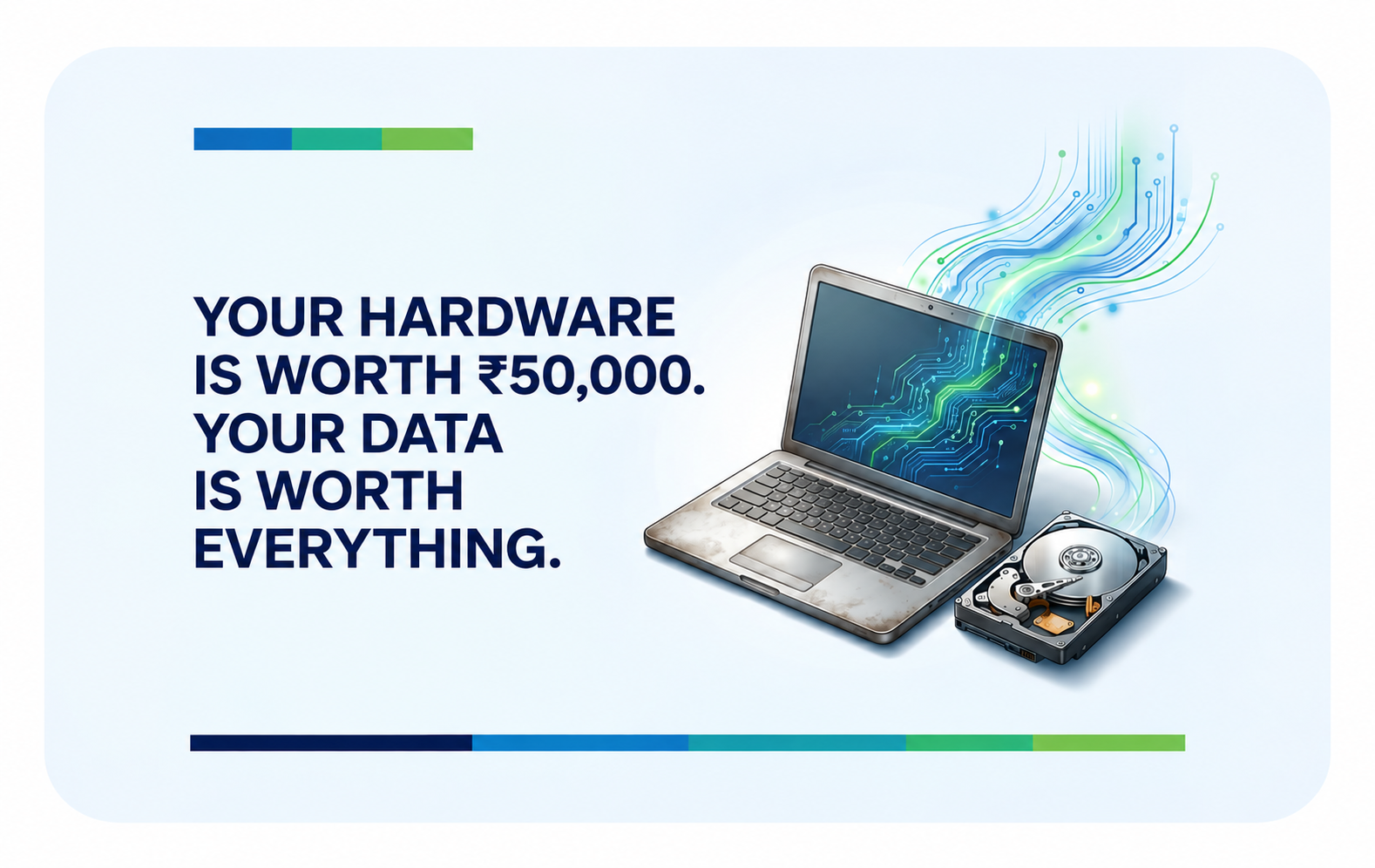
YOUR HARDWARE IS WORTH ₹50,000. YOUR DATA IS WORTH EVERYTHING.
- On
- InData Destruction
When a company decides to retire a batch of old laptops, the conversation usually goes something like this: “How much can we get for them?”
“Just give them to the scrap dealer.
“Format them and donate them.”
The focus is always on the hardware. Its age. Its resale value. How quickly it can be cleared out.
Nobody asks: what data is still on those machines?
That silence is the gap JustDispose was built to fill.
Hardware Is the Medium. Data Is the Message.
Think about what actually lives on a corporate laptop. Not the metal chassis, the screen, or the keyboard. What lives on it is:
- Years of internal emails and client communications
- Employee salary records and personal information
- Customer databases, contracts, and pricing structures
- Login credentials, VPN configurations, and access tokens
- Financial reports, forecasts, and boardroom presentations
- Intellectual property — product designs, source code, trade secrets
Now ask yourself: what is that information worth to a competitor? To a fraudster? To someone who bought that laptop second-hand from a scrap dealer for ₹2,000?
The laptop was worth ₹50,000 five years ago. The data on it could be worth crores — or cost crores — depending on whose hands it falls into.
💡 The real asset: The device is a container. What makes it dangerous when discarded isn’t the hardware — it’s everything the hardware was carrying.
Why Discarding Hardware Is a Data Decision
Every time a business retires a device — a laptop, a server, a mobile phone, a hard drive — it is making a data decision. Whether it realises it or not.
The moment that device leaves your premises without certified data destruction, you have lost control of everything that was ever stored on it. Emails sent. Passwords saved. Client records accessed. Files downloaded and never deleted.
This is not hypothetical. Across India and globally, data breaches have been traced back to improperly disposed hardware. Old corporate devices turning up in second-hand markets — with data fully intact. Hard drives purchased in bulk from recyclers — loaded with sensitive business information from their previous owners.
⚠ The uncomfortable truth: Most Indian businesses treat device disposal as a logistics problem. It is actually a data security problem with legal, financial, and reputational consequences.
Under India’s Digital Personal Data Protection Act (DPDPA) 2023, organisations are legally responsible for protecting personal data at every stage of its lifecycle — including the moment a device is discarded. Getting this wrong isn’t just negligent. It is a compliance violation with penalties that can reach ₹250 crore.
The Three Things Most Companies Get Wrong
1. They think formatting is enough
It isn’t. Formatting removes the file index, not the data. The files remain on the drive, fully recoverable, until they are professionally overwritten or the drive is physically destroyed. This is one of the most persistent and dangerous myths in corporate IT.
2. They treat all devices the same
Not every retired device carries the same risk. A server that processed payroll for ten years carries far more sensitive data than a display unit that was used for demos. A proper IT asset disposal process assesses each device individually — its history, its data classification, and the destruction method appropriate for what it held.
3. They hand devices to whoever is cheapest or most convenient
An unregistered scrap dealer will take your old laptops off your hands quickly and cheaply. What they will not do is certifiably destroy your data, provide an audit trail, or ensure compliance with Indian e-waste regulations. You have outsourced the hardware. You have not outsourced the liability.
✅ What proper disposal looks like: Certified data destruction + documented chain of custody + authorised e-waste recycling + compliance certificates. Anything less leaves you exposed.
So Why Just Dispose?
JustDispose was built on a single insight: that the value — and the risk — of a retired device has nothing to do with its physical condition. It is entirely about what the device contains and what happens to that content when the device leaves your organisation.
Every part of the JustDispose process is designed around that insight:
Data destruction first, always
Before anything else happens to a device — before it is assessed for resale value, before it is recycled, before it leaves your premises — the data is destroyed. Using certified methods (NIST 800-88, DoD 5220.22-M), verified by audit trail, documented with a Certificate of Data Destruction.
Every device assessed on its own terms
JustDispose categorises every retired device individually. Working equipment enters the ITAD refurbishment and resale track, recovering maximum value for your business. Non-working equipment (NWE) is assessed for component salvage before recycling. Fully end-of-life (EOL) material and scrap go directly into the material recovery process. Nothing is treated as generic waste.
Nothing goes to landfill
JustDispose’s R2v3-certified facility near Mumbai operates a zero landfill policy. Every material stream — metals, plastics, glass, precious metals from circuit boards — is processed, recovered, and channelled responsibly. The hardware that carried your data doesn’t become someone else’s environmental problem.
Full compliance, fully documented
Every engagement produces a complete paper trail: asset inventory report, data destruction certificate, e-waste recycling certificate, and EPR compliance documentation where applicable. This is the evidence your business needs for audits, ISO certification, client due diligence, and regulatory inspections.
🏆 Certified at every level: R2v3 globally certified, ISO 27001:2013 for information security, CPCB and MPCB authorised for e-waste processing. JustDispose is compliant at every level — national, state, and international.
Data Is Your Most Valuable Asset. Protect It to the Very End.
Businesses invest heavily in cybersecurity — firewalls, antivirus, encryption, access controls. Yet the same organisations will hand retired laptops to a scrap dealer without a second thought.
That is a gap in your security posture. A physical gap. One that bypasses every digital protection you have put in place.
JustDispose closes that gap. Not just by disposing of hardware — but by treating every retired device as what it actually is: a data security event that requires the same rigour, documentation, and accountability as any other part of your information security programme.
Because the hardware was always just the medium. The data was always the asset.
Ready to Dispose Smarter?
Whether you’re retiring 10 laptops or decommissioning an entire data centre, JustDispose handles it with the security, compliance, and accountability your business deserves.
Certified data destruction — onsite or offsite
ITAD buyback — maximum value from retired assets
R2v3-certified e-waste recycling — zero landfill
Full compliance documentation for every engagement
PAN India service coverage
📧 recycle@justdispose.com | 📞 +91 77680 60001 | 🌐 www.justdispose.com
FAQs
Why is data more important than hardware when disposing old devices?
The hardware has a finite resale or scrap value. The data it contains — client records, financial information, login credentials, intellectual property — can be worth far more, or can cause far more damage if it reaches the wrong hands. Hardware is the container. Data is what matters.
Isn’t formatting an old laptop before discarding it enough?
No. Formatting removes the operating system’s reference to files, not the files themselves. The data remains on the drive and is recoverable with standard tools. Certified data destruction using professional overwriting or physical shredding is required.
What makes JustDispose different from a regular scrap dealer?
JustDispose is R2v3 certified, ISO 27001:2013 certified, and authorised by CPCB and MPCB. Every device is processed with certified data destruction, full audit documentation, and responsible recycling. A scrap dealer offers none of these. The liability for your data remains with you regardless of who you hand devices to — unless certified destruction has been carried out and documented.
What is a Certificate of Data Destruction and do I really need one?
It is a formal document confirming that data on specific devices has been permanently destroyed. You need it as evidence of compliance for audits, ISO certification, DPDPA requirements, and client due diligence. Without it, you have no proof that disposal was handled correctly.
Does JustDispose handle large-scale IT decommissioning projects?
Yes. JustDispose handles everything from single-device disposal to full data centre decommissioning, with PAN India logistics, onsite data destruction capability, and complete compliance documentation for every asset.